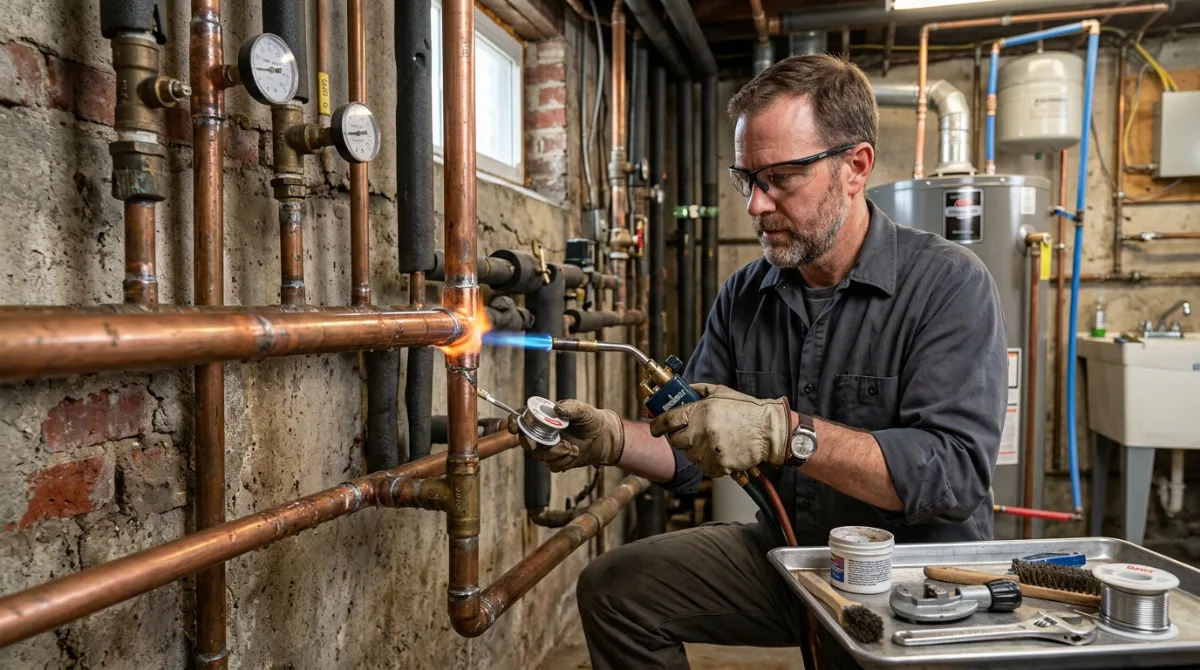
Corrosion
Galvanized steel reaching the end
Internal rust narrows the bore, drops pressure and eventually opens the wall. It fails along the whole system rather than in one unlucky spot, which is why patch after patch stops making financial sense.
Westminster, CA · water stopped first
Corrosion, pressure and age break supply lines in this city, not frost. The sequence is always the same: stop the water, find the failure, repair sound pipe to sound pipe, then explain what caused it so you are not doing this again next year.
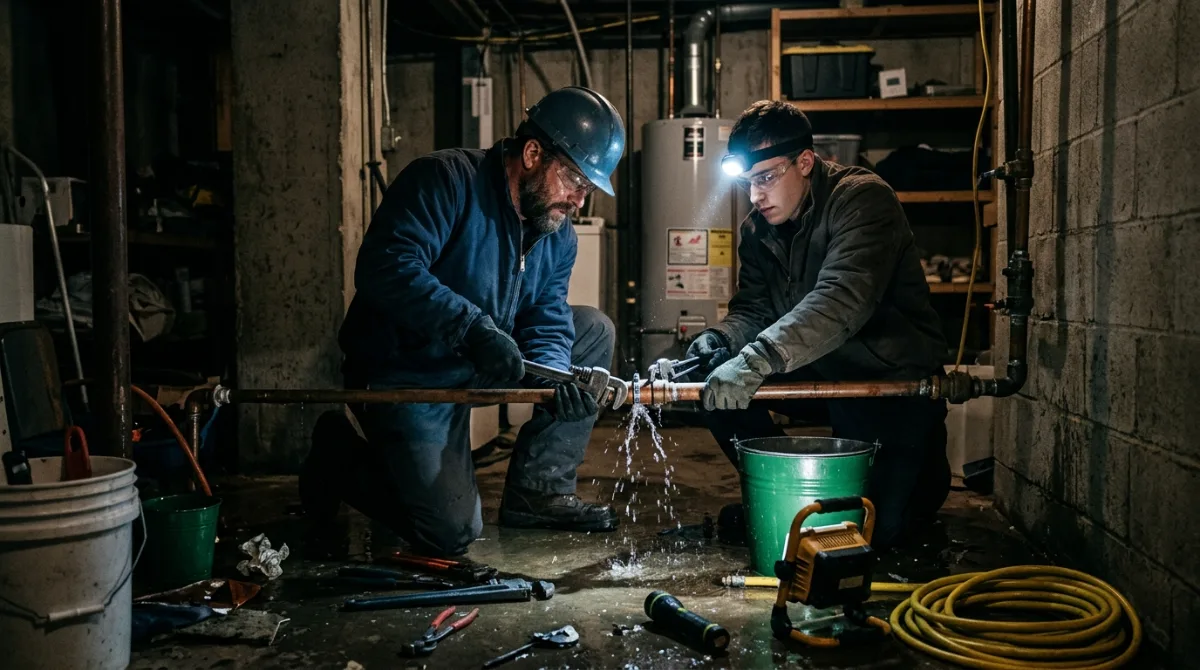
A failure with a history
A burst supply line is the visible end of a process that has been running for years. That is worth knowing, because it changes what a good repair looks like. Splicing in a new length of pipe stops the water. Understanding why that particular section failed is what stops the next one.
In Westminster there are three recurring stories. The first is original galvanized steel, still present in a good share of pre-1960s stock, rusting from the inside until the remaining wall thickness cannot hold pressure. It usually announces itself long before it bursts: rust-tinted water at first draw in the morning, falling pressure, then pinholes. The second is copper attacked from outside or inside, producing neat pinhole leaks that spray rather than gush. The third is mechanical: a shovel through the service line in the front yard, a nail through a stud bay during a remodel, a fence post set straight through a run.
Then there is the multiplier that sits behind all three. Pressure. When a regulator fails or was never fitted, the house takes whatever the street is delivering, and every joint, angle stop, toilet fill valve and appliance hose in the building lives permanently overloaded. Plenty of repeat-failure properties do not have a pipe problem at all. They have a pressure problem that is being paid for one burst at a time.
A repair visit that ends without a pressure reading and a look at the material and age of the rest of the system has answered half the question.
If you can hear water with everything off, that sound is the diagnosis. Call and describe where you hear it.
Root causes
Freeze damage is rare here. These are the failures that fill the schedule instead.
Corrosion
Internal rust narrows the bore, drops pressure and eventually opens the wall. It fails along the whole system rather than in one unlucky spot, which is why patch after patch stops making financial sense.
Pinholes
Aggressive water chemistry, poor grounding or trapped flux produce small perforations that spray fine mist into a wall cavity for weeks before anyone notices the stain.
Pressure
A failed regulator hands the house street pressure. Fast-closing appliance valves add shock loading on top. Together they take years off every joint in the building.
Movement
Lines running through or under a slab are held rigid where the ground is not. Add a hot line expanding and contracting against concrete for sixty years and abrasion does the rest.
Impact
The service line between meter and house sits shallow. Irrigation work, fencing, tree planting and hardscaping all find it. Inside, a mis-set nail can weep for months.
Fittings
Copper joined directly to galvanized without a dielectric fitting corrodes at the junction. Yesterday’s quick fix is frequently today’s failure point, and it is the first thing worth looking at.
The repair sequence
Main off, lowest fixture opened to drain the column, affected circuits killed at the breaker. On the hot side, the heater is shut down so no element or burner runs dry.
Sound, moisture meters and pressure isolation narrow the failure to a bay or a run, so the access opening is cut once in the right place instead of three times hopefully.
Sound pipe to sound pipe, in matching or upgraded material with correct dielectric separation. Where the original path is buried in tile or slab, an overhead reroute is often cheaper and better.
Water back on, joints held under pressure and watched, static pressure measured at a hose bib, then a frank assessment of what the rest of the piping looks like.
You will get the price for the repair, and separately for anything discovered along the way, before it happens.
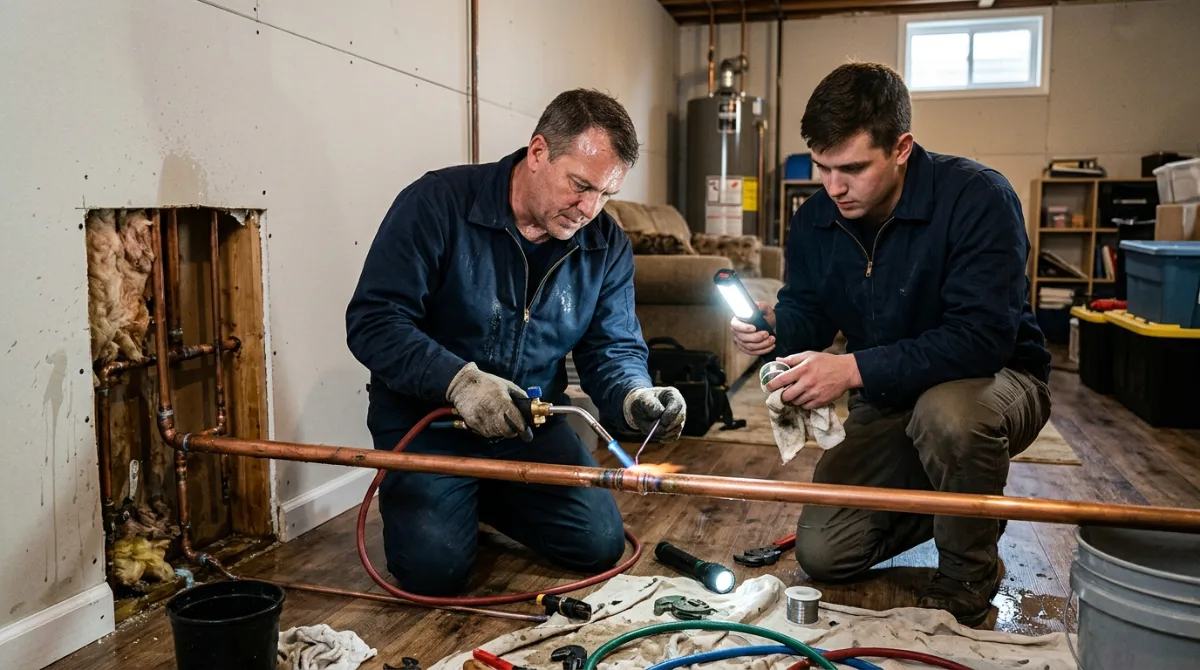
The decision that matters
Every burst ends with a choice, and it should be presented as three options rather than one recommendation. A patch is right when the material is sound and the failure was local: a copper system with one pinhole, an impact break, a bad old fitting. It is the cheapest correct answer, and there is nothing second-rate about it.
A reroute makes sense when the pipe is fine but its location is the problem. Runs buried in a slab, cast into a shower wall or set behind expensive tile can often be abandoned and replaced with a new path through the attic or an adjacent cavity. You pay for slightly more pipe and considerably less demolition and restoration.
A full repipe is the honest answer when the system itself is at the end of its life. Galvanized supply that is already producing rust-tinted water and low pressure will keep failing, and the third patch typically costs more than a staged whole-home repipe would have. Staged is the operative word: it can be done zone by zone so the household never loses water for a full day.
For landlords and property managers, the arithmetic is different again: an occupied unit costs more to open twice than to do once properly, and repeat callouts across a portfolio show up quickly.
Straight answers
Almost everything except cold. In Westminster the common causes are corrosion, galvanized steel supply from the 1950s and 1960s rusting from the inside until the wall gives way, pinhole failure in copper attacked by aggressive water or stray current, mechanical damage from a shovel or a fence post, chronic overpressure from a failed regulator letting the street pressure through unchecked, and water hammer from a fast-closing valve or appliance. Freezing is a footnote here. Age, pressure and chemistry do the work instead.
Listen and look. A burst supply line makes noise: hissing, rushing or a constant trickle behind a wall with everything turned off. You may see a spreading damp patch on a wall or ceiling, water tracking out from under a baseboard, a bubbling spot in stucco, or an unexplained soaked area of lawn over the service line. Pressure drops at the fixtures. The meter dial keeps moving with all taps closed. If the water is warm underfoot on a slab floor, you are more likely dealing with a slab leak on the hot side.
Shut the main: the valve on the house side of the parkway meter box, or the one where the supply enters the exterior wall. Then open the lowest faucet in the property so the standing pressure drains somewhere harmless, and a high fixture as well to let air in. Cut power to any circuit near standing water at the breaker. If the break is on the hot side, close the cold inlet on the water heater and switch its gas or breaker off. Then call, and keep the photos coming while you wait.
It depends entirely on the material and the pattern. A single copper pinhole in an otherwise sound system is a spot repair, and treating it as anything more is a waste of money. A second and third pinhole within a year is a system that is telling you something. Galvanized steel is the clearer case: because it corrodes from the inside along its entire length, one burst usually means the rest is on the same trajectory, and repiping in copper or PEX is the durable answer rather than a run of patches.
Less than you probably fear, and the plumber should show you why before cutting. The access opening needs to expose the failed section plus enough sound pipe either side to make a proper joint, often a single stud bay. Ceilings under a second-floor bathroom sometimes need more because water travels along joists before it drops. Where a wall is finished in tile or a hard-to-match texture, rerouting the run through an attic or an adjacent cavity can be cheaper overall than opening and restoring the original path.
The plumbing repair ends with sound, tested pipe and a clean opening. Patching, texture, paint and flooring are separate trades, and you should expect that to be stated plainly in the quote rather than discovered later. Many plumbers can recommend a drywall or restoration contractor they work with regularly. If an insurance claim is involved, coordinating the plumbing invoice with the restoration scope tends to go more smoothly when both are described in writing from the start.
Yes, and it is one of the most common untreated causes of repeat failures in this area. Residential systems are generally happiest between about 50 and 75 psi. Well above that and you are shortening the life of every supply joint, every angle stop, every appliance hose and every fill valve in the building. A pressure test takes minutes. If the regulator has failed or was never fitted, replacing it is inexpensive compared with the second burst. See water pressure and regulator service.
Generally the utility owns the main and the meter, and the property owner owns the service line from the meter to the building. That is why a soaked strip of lawn between the meter box and the house is a homeowner repair, not a utility call, and it is a fairly common failure on properties old enough to still have the original line. Confirmation is worth having before work starts, and the water district can tell you where their responsibility ends. See water line repair and replacement.
Stop the water first, protect what you can, and notify the landlord or property manager immediately, in writing as well as by phone, with the time you discovered it. In a multi-tenant building the failure may not originate in your unit at all, which matters for who pays. Landlords and managers can call this line directly for after-hours dispatch; for shared plumbing where responsibility is likely to be disputed, camera work during the repair records where the fault actually sat.
Yes, and sometimes it genuinely can. If the failure is isolatable, a single fixture that can be valved off while the rest of the house keeps water, there is little advantage to paying after-hours rates for the full repair. What cannot wait is an unisolatable leak, an active flood, or anything soaking structure or electrical. The honest version of that answer is given on the phone, before anyone is dispatched.
Not sure whether it is a burst line, a slab leak or a drain problem? Describe it and we will narrow it down.
Related work
Answered around the clock
Shut-off guidance while we talk, a local plumber dispatched, and a repair priced before anything is cut.
Same-day windows across Westminster and the neighbouring cities.