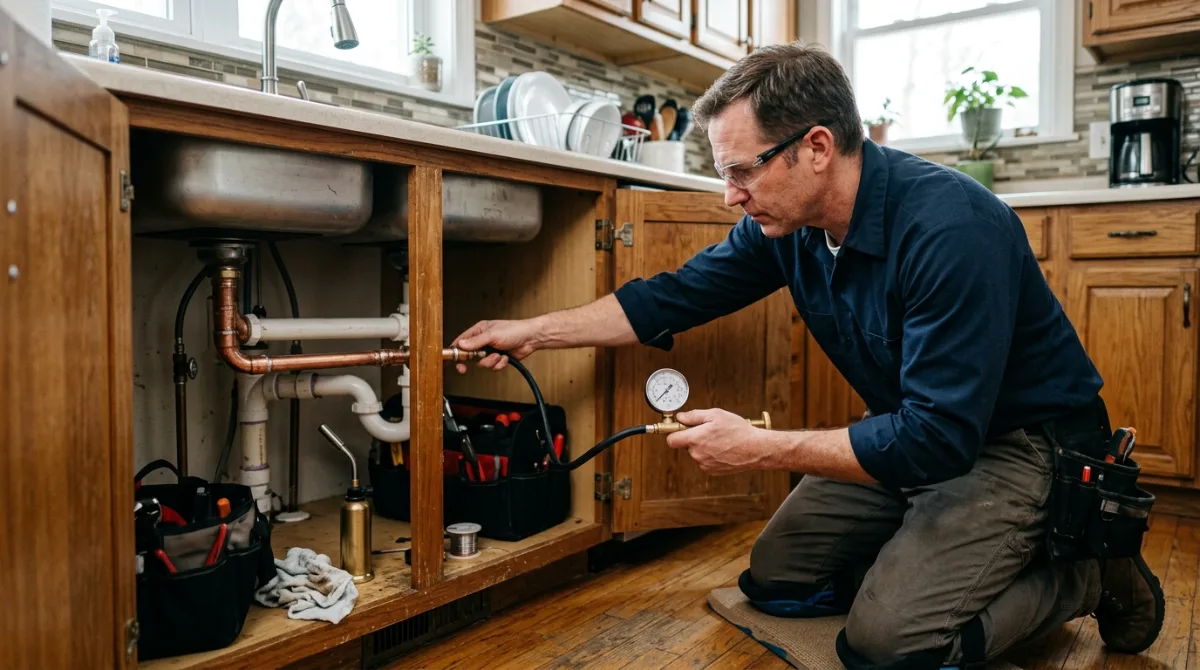
Step one
Meter and pressure testing
Proves a loss exists and how large it is, and separates continuous leaks from intermittent ones. Also the fastest way to rule out the most expensive possibility before spending anything on chasing it.
Westminster, CA · find it before you cut
Acoustic listening, pressure isolation, thermal imaging and line tracing to establish exactly where water is escaping, under slabs, behind tile, inside walls, out in the yard, before a single opening is made.
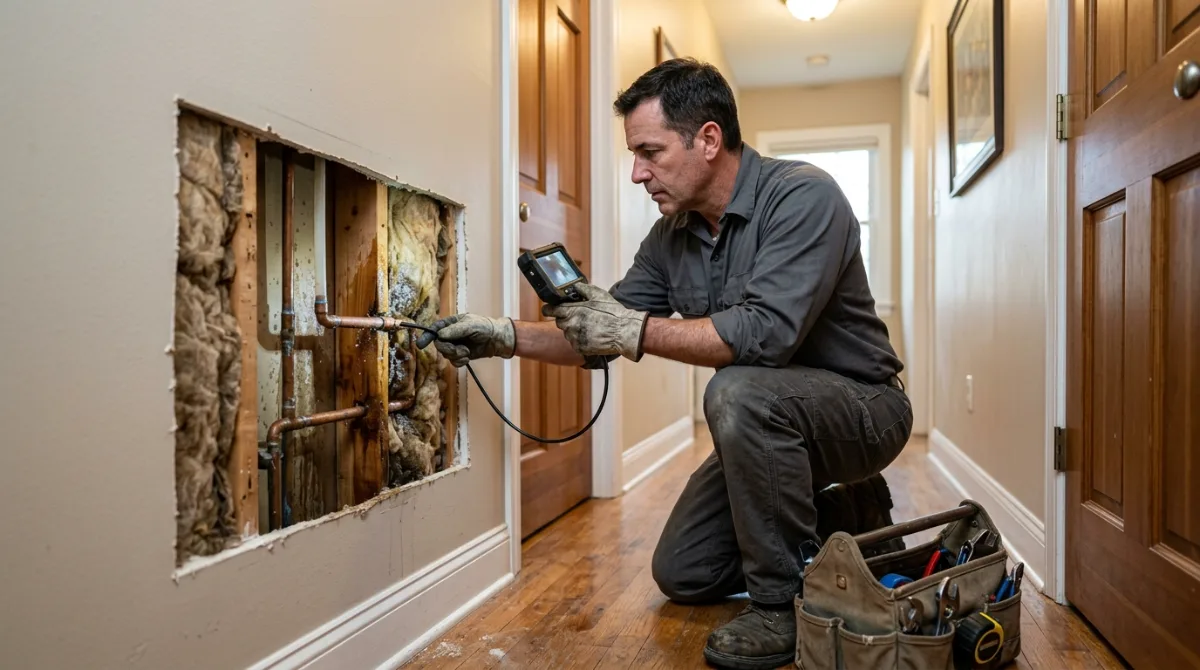
Precision is the cheap part
There is a version of this job that looks cheaper and never is. Someone decides the leak is probably behind the hallway wall, opens it, finds dry framing, and moves on to the next best guess. Two openings later the leak turns out to be six feet away on the other side of a doorway, and now you are paying for three drywall repairs and a repipe you did not need.
Detection replaces that with measurement. First a meter reading and a pressure test to prove water is being lost and estimate how fast. Then isolation, which is the step that does most of the work: house against irrigation, hot against cold, the service line against the interior system. Each valve closed removes a whole category of possibility. By the time listening equipment comes out, the search area is often down to a room.
What you get at the end is specific: a marked point, an identified line, a described failure, and a repair that can be quoted properly because everyone knows what is actually wrong. That is also what makes an insurance conversation or a landlord conversation straightforward instead of a matter of opinion.
It is worth saying that a good number of visits end with a diagnosis nobody expected: a stuck irrigation valve, a toilet flapper passing water silently, a pool fill line, a failed pressure regulator bleeding to drain. Those are cheap problems, and finding them is exactly as valuable as finding an expensive one.
Sound, damp, a bill jump, a warm floor, each one points at a different test. Describe yours and we will tell you which.
The toolkit
No single technique finds every leak. Combining them in the right order is the skill.
Step one
Proves a loss exists and how large it is, and separates continuous leaks from intermittent ones. Also the fastest way to rule out the most expensive possibility before spending anything on chasing it.
Step two
Valving off sections, irrigation, hot side, wings of the house, the service line, and re-testing after each. Unglamorous, and it eliminates more wrong answers than any piece of electronics.
Acoustic
Escaping water under pressure makes a distinctive noise that travels through concrete and soil. Amplification and comparison between listening points narrows it to within inches on a good day.
Thermal
A hot-side leak beneath a slab warms the concrete above it in a readable plume. Also useful for tracking where water has spread inside a wall, which is not always where it entered.
Tracing
Establishes where the buried line actually runs before anyone digs. Owners are frequently wrong about the route, and following an assumption across a yard is how landscaping gets destroyed.
Confirming
For the difficult ones: a safe gas mixture introduced into a drained line and detected where it surfaces, plus moisture meters to map the wettest point through finished surfaces.
Where the water usually is
Hot-side copper beneath 1950s and 1960s concrete. Warm floors, running-water sound, a bill that climbed. The most common hidden leak in this city, by a distance. See slab leak repair.
Between meter and house, often shallow and often disturbed by later landscaping. A soggy strip of lawn or a damp driveway edge that never dries out.
Valve bodies, pan liners and diverters leaking only while the shower runs, showing up as a stain on the other side of the wall or the ceiling below.
A weeping valve or a cracked lateral loses a remarkable volume quietly, and it never shows on a floor. Always tested early because it is cheap to rule out.
A weeping T&P valve, a corroded nipple or a drip pan that has been quietly draining for months. Easy to see once you look, and routinely missed.
In duplexes and multi-tenant buildings, the leak is often not in the unit that reported it. Isolation testing establishes whose line it is before the argument starts.
Useful for insurers, landlords and property managers, and for deciding what to repair first.
Straight answers
It starts with the meter and a pressure test to prove there is a loss and measure roughly how big it is. Then the system is divided: house versus irrigation, hot versus cold, upstairs versus down, so the search area shrinks before any equipment comes out. From there it is acoustic listening, electronic amplification, thermal imaging and, where needed, tracer gas or line tracing. The output is a marked location and a written description of what was found, not a vague area of suspicion.
That is the entire purpose. Non-invasive methods, listening, thermal, pressure isolation, line tracing, are used first and answer most jobs. Occasionally a small access point is needed to confirm a location before committing to a larger opening, and that is discussed with you first. The tests are chosen to avoid demolition, which is precisely why locating properly is cheaper than exploratory cutting even though it looks like an extra step.
Yes, and it is one of the most common reasons people call. A bill increase with no change in usage means water is going somewhere. The meter test tells us within minutes whether the loss is continuous, and isolation tells us whether it is inside the house, in the service line from the meter, in the irrigation system or in a pool or spa circuit. Plenty of visits end with the news that it is a sprinkler valve, which is a very good outcome.
The service line between the meter and the house is traced electronically to establish its actual route, which is frequently not where the owner assumes. Acoustic ground microphones then listen along that route for the escape noise, which carries well through soil and hardscape. Pressure testing confirms the section. The result is a single small excavation over the fault instead of a trench following a guess. See water line repair and replacement.
Yes, and it is one of the first things established, because it halves the search. Isolating the cold inlet at the water heater and re-testing pressure shows immediately which side is losing. Hot-side leaks under a slab also give themselves away thermally: a warm floor and a heat signature the camera can read. Hot leaks tend to be more urgent too, because the water heater keeps working the whole time.
Irrigation and service lines, yes. Those are routine and often the answer to a mystery bill. Pool shell and spa leak work is a distinct specialism with its own equipment and dye testing, so if the diagnosis points there you will be told plainly rather than sold a service that does not fit. What matters is that the isolation testing distinguishes between them properly, so nobody spends a day chasing a house leak that was a pool line.
A stain with no obvious source is usually one of four things: a supply pinhole spraying inside a cavity, a drain or waste leak that only shows when a fixture is used, a shower pan or valve leaking behind tile, or condensation. The tests differ. Moisture mapping finds the wettest point, pressure isolation separates supply from drain, and running individual fixtures while monitoring the area distinguishes a drain leak from a constant one. See shower and tub plumbing.
Almost always, because roughly is expensive. Opening a wall or a slab in the wrong place costs more than the location work, and the second and third openings cost the same again. Detection also tells you what kind of failure you have, which determines whether the correct repair is a patch, a reroute or something larger. Knowing the pipe, the depth and the exact point turns an open-ended job into a defined one with a real price.
The tools are the same; the logistics are not. Multi-tenant buildings, restaurants and retail along the Bolsa Avenue and Westminster Boulevard corridors have shared risers, shared laterals and meters that serve several units, so isolation testing has to work out whose water is being lost before anything else. That question is frequently the real reason for the call. Testing is scheduled around trading hours, and the written findings matter because they usually get shared with a landlord or manager.
If the loss is significant, you can hear it, or the meter is spinning, shutting the main between uses is sensible and costs you nothing but convenience. For a small continuous loss, leave the system as it is, because a leak that is actively running is easier to find than one that has been switched off for a day. Do not repair, patch or cover anything before the visit; an untouched leak is the fastest one to locate.
Same-day slots are usually available, and emergencies come first.
Related work
Westminster, CA · 24/7 line
One visit, a marked location, and a repair that can finally be priced properly.
Homes, rentals, restaurants and multi-tenant buildings across west Orange County.